
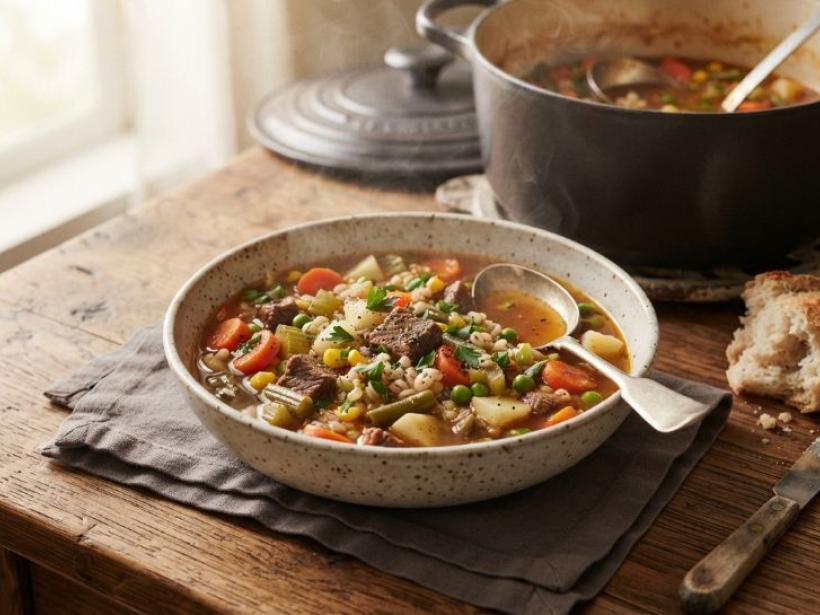

A good vegetable beef soup recipe needs two things: beef that falls apart on your spoon and vegetables that still have some bite. This version gets both by adding ingredients in stages. First, you brown chunks of chuck and let them simmer alone for an hour. Next, the potatoes and carrots go in, and frozen corn and green beans join at the very end.
Beginners can follow the steps exactly and end up with a satisfying pot of soup. Experienced cooks will find notes on browning, seasoning and texture along the way. Either way, you get eight big bowls and leftovers that taste even better the next day.
Active Time: 40 minutes
Total Time: 2 hours 15 minutes
Servings: 8
Ingredients
Most of these ingredients are pantry staples. Pick up low-sodium broth if you can, since it lets you control the salt yourself.
For the beef and base
- 1½ lb beef chuck stew meat, cut into 1-inch cubes
- 2 tablespoons olive oil
- 1 medium onion, diced
- 2 carrots, sliced into coins
- 2 celery stalks, diced
- 3 garlic cloves, minced
- 2 tablespoons tomato paste
- 1 can (14.5 oz) diced tomatoes, no salt added
- 6 cups low-sodium beef broth
- 1 bay leaf and 1 teaspoon dried thyme
- Black pepper and salt, to taste
For the vegetables
- 1 lb russet or Yukon Gold potatoes, cut into ¾-inch cubes
- 1 cup frozen green beans
- 1 cup frozen corn
- Chopped fresh parsley, to serve
Instructions
The method runs in three stages. You prep and brown, then simmer in two steps, and finally season and serve. Each part below answers a question home cooks often ask.
Preparation
Which cut of beef works best?
Chuck makes the best choice for this recipe. It carries enough fat and connective tissue to turn tender during a long simmer. Leaner cuts, like round, tend to stay dry and stringy.
Kristine's Kitchen suggests buying a chuck roast and cubing it yourself. That way, you can trim thick pieces of fat and keep the cubes an even size. Pre-cut stew meat works too, but it often mixes several cuts, so some pieces may stay firmer than others.
How do you prep the vegetables?
Dice the onion and celery small, and slice the carrots into coins. Keep the potatoes in a bowl of cold water until you need them, so they don't brown.
Meanwhile, pat the beef dry with paper towels and season it with pepper. Dry meat browns faster. Wet meat steams instead.
Cooking
Why brown the beef first?
Browning builds most of the soup's flavor. Heat 1 tablespoon of oil in a Dutch oven over medium-high heat. Add half the beef in a single layer and leave it alone for 3 to 4 minutes. Then turn the pieces and brown the other sides.
Move the first batch to a plate and repeat with the rest, adding more oil if the pot looks dry. Crowding the pot drops the temperature, and the beef will turn gray instead of brown.
Building the base
Lower the heat to medium. Add the onion, carrots and celery to the same pot, and stir them through the browned bits on the bottom for 5 to 6 minutes. After that, add the garlic and cook for about a minute, until it smells fragrant.
Stir in the tomato paste next. Cook it for 2 minutes, until it darkens slightly. This deepens the flavor and takes away the raw, tinny taste.
How long should the soup simmer?
Return the beef and its juices to the pot. Pour in the broth and diced tomatoes, then add the bay leaf and thyme. Bring everything to a boil, lower the heat, cover and simmer for 1 hour.
At that point, add the potatoes and simmer for another 30 minutes. Kristine's Kitchen uses the same staged approach, adding the longer-cooking vegetables only after the first hour. Test a cube of beef. It should break apart easily with a spoon. If it still feels firm, give it 15 more minutes.
Finally, stir in the frozen green beans and corn. Cook them for 5 minutes, just until hot. Fish out the bay leaf, then taste and season with salt and pepper.
Serving
What should you serve with vegetable beef soup?
Ladle the soup into deep bowls and scatter parsley over the top. Crusty bread, cornbread or a simple green salad all go well with it.
For a thicker bowl, mash a few potato cubes against the side of the pot and stir them back in. This thickens the broth without flour.
How do you store and reheat leftovers?
Cool the soup quickly. USDA guidance says to refrigerate cooked food within two hours. It also recommends shallow containers, no more than 3 inches deep, so large batches cool faster.
In the fridge, the soup stays safe for 3 to 4 days. For longer storage, freeze it. Soups keep their best quality for about 2 to 3 months in the freezer. When you reheat, bring the soup to a boil.
Nutritional Value Per One Serving
The figures below are my estimate, worked out ingredient by ingredient:
- Beef: USDA FoodData Central values for raw Choice chuck stew meat (130 calories and 21.6 g protein per 100 g).
- Broth: the label for Swanson 50% Less Sodium Beef Broth (10 calories and 410 mg sodium per cup).
- Vegetables, oil and tomatoes: standard USDA values.
The estimate doesn't include salt you add at the table.
Here's the math for calories. The whole pot comes to about 1,913 calories. Divided by 8 servings, that's about 240 calories per bowl. I calculated every other line the same way.
| Nutrition Facts | One serving (about 1½ cups) |
|---|---|
| Calories | 240 |
| Total Fat | 8 g |
| Saturated Fat | 2 g |
| Cholesterol | 54 mg |
| Sodium | 405 mg |
| Total Carbohydrates | 21 g |
| Dietary Fiber | 3 g |
| Sugars | 4.5 g |
| Protein | 23 g |
Estimates only. Your numbers will change with the broth brand, the fat on your beef, and how much salt you add.
Is vegetable beef soup healthy?
It's a balanced bowl. You get about 23 g of protein, some fiber, and plenty of vegetables for around 240 calories.
The broth matters most for sodium. Swanson's regular beef broth lists 830 mg of sodium per cup, compared with 410 mg for its lower-sodium version. With 6 cups in the pot, that's a difference of 2,520 mg (6 × 420 mg). Split across 8 servings, it works out to about 315 mg more per bowl with the regular broth.
Tips and Variations
How do you keep the vegetables from turning mushy?
Timing solves most of it. Soft vegetables like peas, corn and green beans need only a few minutes. Potatoes and carrots handle longer cooking.
Also, cut the potatoes into even pieces. Uneven cubes cook at different speeds, so small bits break down while big ones stay hard.
Easy swaps and variations
Once you know the base method, beef and vegetable soup recipes are easy to adapt:
- Ground beef: Dinner at the Zoo suggests 1½ lb of lean ground beef in place of stew meat, which cuts the simmering time a lot.
- Slow cooker: brown the beef and vegetables first, then cook on low for 6 to 8 hours. Add the potatoes after 4 hours and the frozen vegetables just before serving, as Dinner at the Zoo does.
- Extra depth: Recipe Runner adds a splash of balsamic vinegar and a Parmesan rind while the soup simmers. Remove the rind before serving.
Notes for experienced cooks
Want a richer broth? Replace 1 cup of the beef broth with dry red wine. Pour it in right after the tomato paste, and let it bubble for a few minutes before you add the rest of the liquid.
For a clearer, more refined soup, skim the fat off the surface during the first simmer. Better still, chill the soup overnight and lift off the solid fat the next day.
Conclusion
This recipe for vegetable soup with beef rewards patience more than skill. Browning the beef well and adding vegetables in stages makes the biggest difference. As a result, you get tender beef and vegetables that still hold their shape.
Make a full pot on a slow afternoon. Then enjoy it through the week, or freeze a few portions for busy nights. Of all the soup recipes with beef and vegetables, this is the one to keep in rotation, and you can change the vegetables every time you make it.