
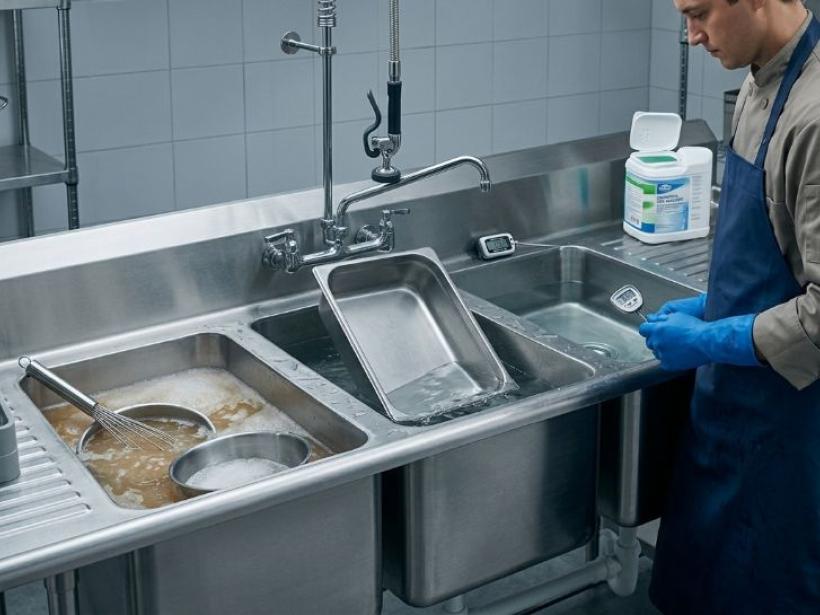

Why exactly three compartments
Manual dishwashing in a commercial kitchen isn't just about getting dishes clean - it's a regulated process with specific steps that health inspectors check line by line. A properly sized three-compartment sink is what the process is actually built around, and understanding why it has three basins - not two, not four - explains a lot about how commercial sanitation works.
- Compartment 1 is for washing: hot water and detergent to remove food residue and grease.
- Compartment 2 is for rinsing: clean water to remove soap and loosened debris before sanitizing.
- Compartment 3 is for sanitizing: a chemical sanitizer at the correct concentration, or hot water held at the required temperature (typically at least 171°F), checked with a thermometer rather than guesswork.
Skipping or combining any of these three steps is one of the most common violations inspectors cite, because it can look like proper dishwashing is happening even when the sanitizing step has been shortchanged.
What the code actually requires
According to the FDA Food Code, which most state and local health departments adopt as the baseline standard, manual warewashing facilities must provide this three-step wash-rinse-sanitize sequence, along with accessible test strips or a thermometer to verify sanitizer concentration or water temperature. Each compartment also needs to be large enough to fully submerge the biggest items regularly washed by hand - sheet pans, stock pots, hotel pans - because partial submersion during sanitizing doesn't meet code even at the right temperature or concentration.
Material and long-term upkeep
304-grade stainless is the standard for these sinks because it resists the chlorides in both dish detergent and chemical sanitizer far better than 430-grade, which is more prone to pitting where sanitizer residue sits against the metal overnight. NSF-certified units are built to this material standard along with the coved corners and integrated drainboards that code inspectors look for.
NSF/ANSI Standard 3 specifically governs commercial warewashing equipment, covering not just basin material but drain fittings, overflow protection, and the minimum compartment depth needed to fully submerge standard hotel pans - details worth checking against the exact model rather than assuming any three-basin sink automatically qualifies.
Basic upkeep is simple but easy to skip under time pressure: rinse sanitizer residue at the end of a shift rather than letting it dry on the steel, and avoid steel wool for scrubbing, since embedded particles left behind can rust and stain an otherwise clean sink.