
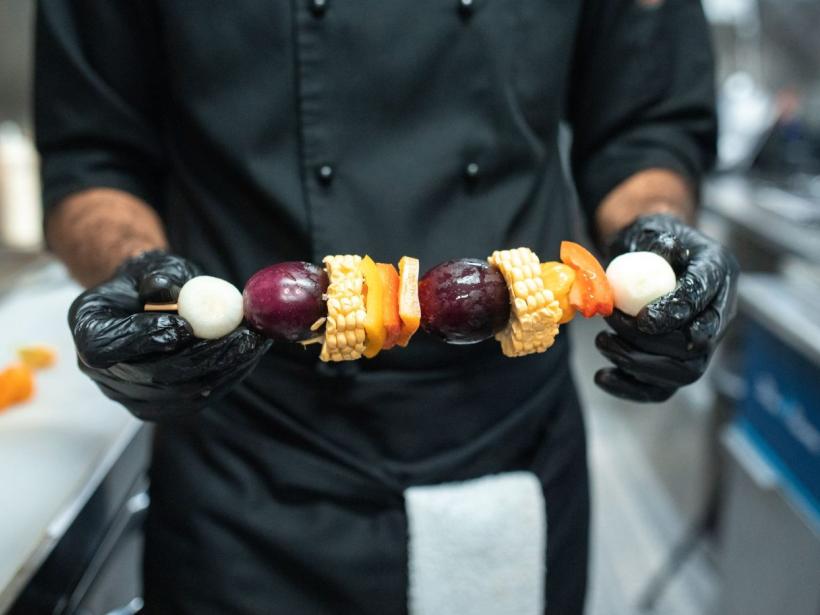
Which ingredients hold up on a skewer?
The firm-versus-soft rule decides whether your skewer appetizers hold together or collapse on the platter. Firm cheese, crunchy vegetables, olives and dense fruit grip the stick and keep their shape for hours. Soft cheese, ripe tomato and watery cucumber slide around and release juice that makes everything soggy.
Choose ingredients that pass a simple squeeze test: press the piece between your fingers, and if it dents easily or feels wet, skip it. A block of cheddar cut into 1-inch (2.5 cm) cubes works, while fresh mozzarella weeps. Cherry tomatoes are the one soft exception; leave them whole with the skin intact and they behave.
- Hard or semi-hard cheese such as cheddar, gouda or halloumi, cubed
- Blanched broccoli or cauliflower florets, cooled and patted dry
- Cucumber spears with the seedy center scraped out
- Whole pitted olives, green or kalamata
- Firm fruit such as pineapple chunks, grapes or melon balls
- Roasted baby potatoes, cooled so they firm up again
How do you stack a skewer so it stays put?

Start with the heaviest, widest piece at the bottom and thread upward toward lighter pieces. A 1-inch (2.5 cm) cube of firm cheese or a thick slice of courgette acts as a stopper, so the rest of the stack has something to sit on instead of sliding toward the tip.
Alternate textures as you go: something dense, then something juicy, then something crisp. A cherry tomato between two cheese cubes keeps the stack from tasting flat. Leave a 1/4 inch (6 mm) gap between pieces so the skewer can grip each one, and push the top piece down until it touches its neighbor.
Finish with a folded basil leaf, an olive, or a small piece of roasted pepper. Light pieces at the top won't drag the stack sideways the way a heavy chunk would.
- Use bamboo skewers soaked in water for 20 minutes so they don't scorch under a broiler.
- Thread on a flat surface, not in your hand, so the pieces line up evenly.
- Keep 1 inch (2.5 cm) of bare skewer at each end for handling.
- Press each piece gently until it squeaks against the one below.
- Build no more than 4 inches (10 cm) of food per skewer so it stays balanced.
What are the best meatless combinations to try?
Each of these pairings makes one skewer, with every ingredient small enough to eat in a single bite. Thread the pieces in the order written and the skewer will balance on the plate.
- Caprese: 1 cherry tomato, 1 small basil leaf folded in half, 1 cube of mozzarella about 2 cm, finished with a drop of balsamic.
- Mediterranean: 1 pitted green olive, 1 cube of feta, 1 piece of roasted red pepper cut to match the feta.
- Garden crunch: 1 cucumber cube, 1 pitted kalamata olive, 1 cube of red bell pepper, all cut to 2 cm.
- Sweet and salty: half a strawberry, 1 small cube of cheddar, half a grape.
- Roasted root: 1 cooked baby potato, 1 cube of roasted beet, 1 small pickle spear folded once.
- Melon and mint: 1 cube of cantaloupe, 1 fresh mint leaf, 1 cube of mild white cheese.
Keep every piece on a skewer close to the same size, roughly 2 cm, so nothing slides off and the flavors stay even from bite to bite. Softer items like melon or mozzarella work best in the middle, between two firmer pieces.
How far ahead can you assemble skewers?

Most meatless skewers can be built 24 hours ahead if you keep wet ingredients away from dry ones. Firm cheese, olives, and blanched vegetables hold for a full day in the fridge. Cut fruit and soft cheese are better added within 2 hours of serving, and fresh herbs or delicate greens go on last, about 30 minutes before the platter leaves the kitchen.
Drying out is the main risk. Wrap cut cheese tightly in plastic wrap or store it in a sealed container with a damp paper towel, and toss cut apple, pear, or banana in lemon juice before skewering. Keep assembled skewers in a single layer under a loose cover rather than stacked, so nothing presses and releases water.
- Blanch firm vegetables 1-2 minutes, then chill them fully before skewering.
- Thread olives and pickles straight from the jar and pat them dry.
- Add cut fruit no more than 2 hours ahead and brush it with citrus juice.
- Skewer soft cheese and fresh basil within 30 minutes of serving.
Which sauces go with meatless skewers?

A thick dip that clings to the skewer works better than a runny one. Make all three below up to a day ahead and keep them covered in the fridge.
- Lemon-herb yogurt: stir 1 cup (240 g) plain Greek yogurt with 1 tbsp lemon juice, 1 tbsp olive oil, 1 tsp dried oregano and a pinch of salt for 1 minute. Serve it with cucumber, cherry tomato and feta skewers.
- Mustard-honey vinaigrette: whisk 2 tbsp Dijon mustard, 1 tbsp honey, 3 tbsp olive oil and 1 tbsp apple cider vinegar for about 1 minute until creamy. Serve it with roasted potato and halloumi skewers.
- Green olive tapenade: blend 1 cup (140 g) pitted green olives with 1 small garlic clove and 2 tbsp olive oil for 30 seconds, then thin with 1 to 2 tbsp more oil until spoonable. Serve it with mozzarella and sun-dried tomato skewers.
Set each sauce in its own small bowl with a spoon, so guests do not double-dip skewers. If a dip thickens in the fridge, loosen it with a teaspoon of cold water and stir for 20 seconds.
How do you serve and transport a skewer platter?
Lay skewers flat in a single layer on a rimmed tray, handles all pointing the same way, and leave a 1-inch (2.5 cm) gap between rows so guests can pick one up without touching its neighbours. Standing them upright in a glass or a halved cabbage works on a table, but flat trays travel better and hold more.
For the road, pack the tray inside a cooler bag with a folded towel underneath to stop sliding, and keep the sauce in a separate lidded jar. A skewer sitting in sauce for 30 minutes turns soft and slick, so sauce the platter at the destination, not at home.
- Chill the platter for 20 minutes before moving it so the cheese firms up.
- Wrap the tray in plastic film and press it down gently, then peel it back slowly on arrival.
- Carry the sauce jar upright in a cup holder or wedged between two ice packs.
- Set out a small bowl for used skewers so guests do not stack them back on the platter.
- Replenish in small batches, about 12 skewers at a time, to keep the rest cold.
Frequently asked questions
Can I make meatless skewers a day ahead?
Yes. Keep the components separate. Cut the vegetables, cube the cheese and mix the sauces the day before, then thread everything the morning of the event. Assembled skewers dry out in the fridge after about 12 hours, so thread them close to serving time.
What can I use instead of toothpicks?
Short bamboo skewers work well for larger bites, and rosemary sprigs stripped of their lower leaves make a fragrant, edible stick for firm ingredients. For soft fruit, use a chilled fork to thread it so it does not tear.
How do I stop apple or pear skewers from browning?
Toss the cut fruit in a little lemon juice before threading. One tablespoon of juice coats about 2 cups (300 g) of cubes and buys you a few hours of bright color without changing the taste.
Are these skewers suitable for a vegan guest?
Many are, as long as you leave out the cheese and yogurt. Build a separate tray with olives, cherry tomatoes, cucumber, roasted pepper and fruit, and serve the mustard-honey vinaigrette only with the non-vegan platter.
Photo: RDNE Stock project, Pexels (Pexels License)