
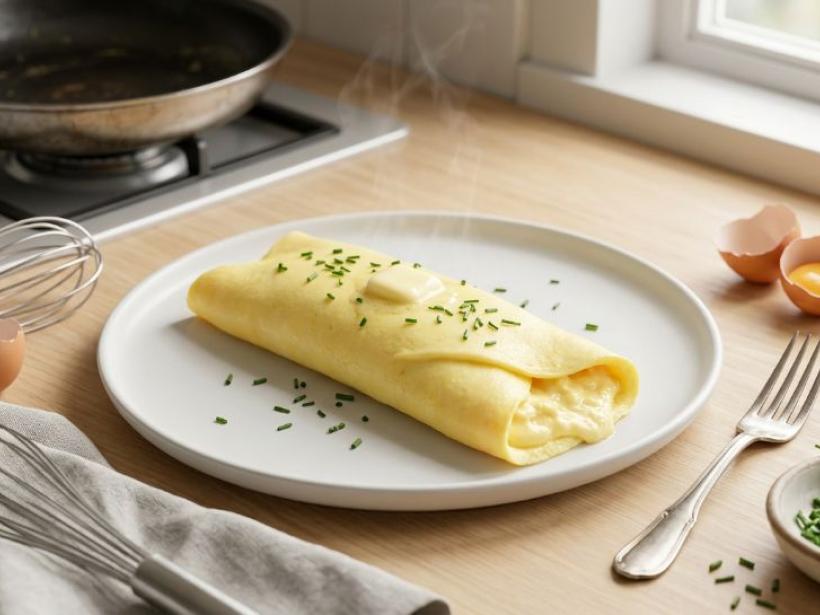

A French omelette stays pale and soft, rolled instead of folded, with no color on the outside at all. That single detail trips up more home cooks than anything else about it. Once you know how to make a french omelette the right way, a diner-style omelette with brown edges starts to look like a different dish entirely.
Just eggs, butter, and a little patience with the heat. That's the whole ingredient list for how to make a perfect french omelette. Nothing fancy, but the technique matters more than what's in the bowl.
Active Time: 5 minutes.
Total Time: 5 minutes.
Servings: 1.
Ingredients
-
3 large eggs
-
1 tbsp unsalted butter
-
1 pinch salt
-
1 pinch white pepper (optional)
-
1 tbsp fresh herbs, chopped (chives or parsley work well)
Instructions
Preparation
Crack the eggs into a bowl and whisk them hard for a full minute, longer than most recipes suggest. The extra whisking breaks the eggs down enough that the finished omelette turns out smooth instead of stringy. Season with salt at this point, not after cooking, since salt added late sits on the surface instead of dissolving into the eggs.
Cooking
Melt the butter in a nonstick pan over low heat. Low heat is the part people skip, and it's the reason so many french omelettes end up browned instead of pale. Once the butter foams but hasn't browned, pour in the eggs.
Stir constantly with a fork or spatula, keeping the eggs moving across the pan for about 20 seconds. When they start to set but still look glossy on top, stop stirring. Let them sit for another 10 seconds so the bottom firms up just enough to hold together.
Serving
Tilt the pan and use a spatula to roll the omelette from one edge to the other, ending with the seam on the bottom. Slide it onto a plate seam-down. Scatter the herbs over the top and serve immediately, since a French omelette keeps cooking a little from residual heat even off the stove.
Nutritional Value Per One Serving
Nutrition Facts, One Serving
|
Nutrient |
Amount |
|
Calories |
260 |
|
Total Fat |
21g |
|
Saturated Fat |
9g |
|
Cholesterol |
555mg |
|
Sodium |
380mg |
|
Total Carbohydrates |
1g |
|
Dietary Fiber |
0g |
|
Sugars |
0g |
|
Protein |
16g |
Tips and Variations
A classic French omelette stays plain, no cheese, no fillings folded inside, though a small spoonful of soft cheese won't ruin it if you're set on adding something. A few other notes worth knowing:
- Use a smaller pan than you think you need, around 8 inches, so the eggs stay thick instead of spreading thin
- Wooden or silicone spatulas work better than metal ones, since metal can scratch a nonstick pan during the constant stirring
- If the eggs brown at all, the pan was too hot, not the technique
Conclusion
Learning how to make the perfect french omelette takes a few tries before the timing clicks, and the first one or two will probably end up a bit uneven. That's normal. Once the rolling motion feels familiar, the whole thing takes under two minutes from egg to plate.